📦
Products & Catalog Data
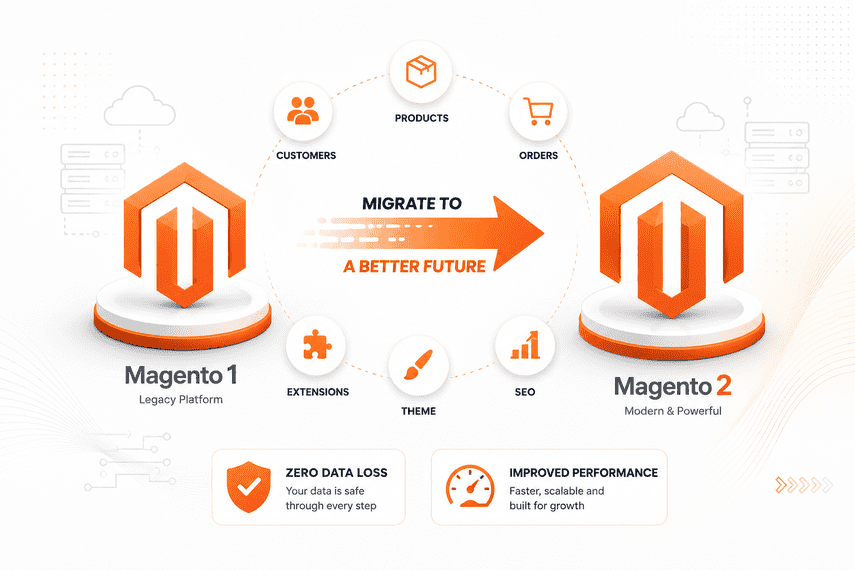
Migrate products, categories, attributes, configurable and bundled products, pricing, inventory data, media, and other catalog information based on your Magento 1 data structure and Magento 2 requirements.
👥
Customers & Order History
Migrate customer accounts, addresses, order history, and related customer data while validating records after migration. Customer authentication is reviewed as part of the migration plan.
🎨
Theme & Storefront Migration
Rebuild your Magento 1 storefront for Magento 2 while preserving your brand, layouts, key customer journeys, and business requirements. The frontend can also be modernized where appropriate.
🧩
Extension Migration & Replacement
Review your existing Magento 1 extensions and determine whether each should be replaced, rebuilt, reconfigured, simplified, or removed based on Magento 2 compatibility and current business requirements.
⚙️
Custom Modules & Business Logic
Analyze Magento 1 custom modules and business logic, then redevelop required functionality using Magento 2 architecture, supported development practices, APIs, and appropriate extension points.
🔌
ERP, CRM & Third-Party Integrations
Assess and reconnect critical integrations such as ERP, CRM, payment gateways, shipping systems, inventory platforms, marketplaces, marketing tools, and other third-party services.
🔍
SEO & URL Migration
Protect important organic search signals through URL mapping, 301 redirects, metadata, canonical tags, XML sitemaps, internal links, and post-migration SEO validation.
⚡
Performance & Technical Optimization
Configure the Magento 2 environment for performance with appropriate caching, indexing, database, search, frontend, and server-level optimizations based on your store's requirements.
✅
Testing, UAT & Final Data Sync
Validate catalog, customer accounts, checkout, payments, shipping, integrations, SEO, performance, and critical business workflows before the final production cutover and data synchronization.