
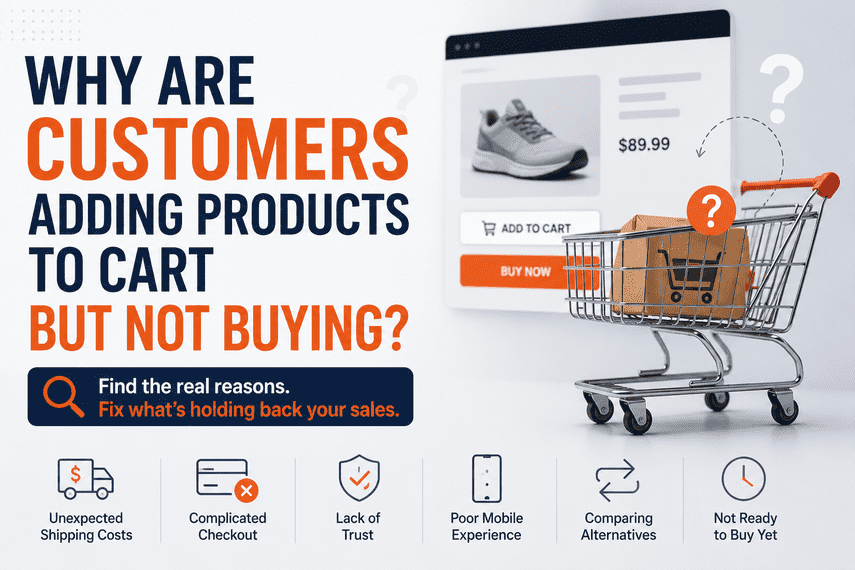

Why Are Customers Adding Products to Cart But Not Buying?
Your customers have already shown buying intent. So why are they leaving after adding products to their cart? Discover what may be stopping them from completing the purchase.
This is one of the most frustrating situations for an eCommerce business.
A customer visits your store.
They find a product. They look at it. They decide they want it.
And they add it to their cart.
Then...
They leave without completing the purchase.
At first glance, it can be tempting to think:
"At least they were interested."
But from a business perspective, this behavior contains an important signal.
The customer has already moved much further through the buying journey than someone who simply visits your website.
They have demonstrated some level of purchase intent.
So the important question becomes:
"What happened between 'I want this' and 'I'm going to complete this purchase'?"
The Customer Has Already Crossed Several Barriers
A typical buying journey looks something like this:
Unexpected Costs Can Change the Purchase Decision
A customer may be comfortable with the product price when they add the item to their cart.
Then they reach the cart or checkout and discover:
- Unexpected shipping charges.
- Taxes they didn't anticipate.
- Handling or service fees.
- Other additional costs.
Suddenly, the purchase feels different from the decision they originally made.
The customer didn't necessarily change their mind about the product. The total purchase changed.
This is why pricing transparency throughout the customer journey matters.
The Customer May Not Know When Their Order Will Arrive
Customers aren't only buying the product.
They're also buying an expectation about when and how that product will arrive.
Questions such as:
If delivery expectations aren't clear, uncertainty can stop the purchase.
Checkout May Be Asking for Too Much
Once the customer has decided to purchase, checkout should make completing the transaction as straightforward as possible.
But checkout can introduce friction through:
- Too many fields.
- Unnecessary information requests.
- Multiple screens.
- Confusing instructions.
- Complicated forms.
- Unclear error messages.
Each additional step creates another opportunity for the customer to stop.
The goal isn't simply to make checkout shorter. It's to make it easier to complete.
Being Forced to Create an Account Can Create Friction
Some customers don't want another account.
They want to complete the purchase and move on.
If creating an account is mandatory before purchasing, some customers may decide the effort isn't worth it.
This is particularly relevant for first-time buyers who haven't yet developed a relationship with your brand.
Ask yourself whether every checkout requirement is necessary for completing the transaction.
Customers May Not Find a Payment Method They Prefer
A customer can be ready to purchase and still encounter a final obstacle at payment.
Depending on your market and customer base, customers may expect different payment methods.
When their preferred option isn't available, they may postpone the purchase or leave.
The important point isn't simply to add every possible payment method.
It's to understand:
Which payment options matter most to your customers?
The Customer May Suddenly Start Questioning the Purchase
Adding something to a cart doesn't always mean the customer has completely committed psychologically.
At checkout, they may have a moment to reconsider.
They may think:
This is why the checkout experience isn't purely functional.
It is also part of the customer's final decision.
Trust Concerns Can Become More Important at Checkout
The closer customers get to payment, the more important confidence can become.
They may look for reassurance around:
- Payment security.
- Return policies.
- Refund processes.
- Shipping information.
- Company credibility.
- Customer support.
- Order guarantees.
If the customer encounters uncertainty at the moment they are expected to enter payment information, that uncertainty can become a reason to stop.
Mobile Checkout May Be Creating Problems
Checkout can feel very different on a phone.
Customers may have to deal with:
- Small form fields.
- Difficult dropdowns.
- Keyboard-related problems.
- Slow pages.
- Payment issues.
- Confusing navigation.
- Long forms.
A checkout that works perfectly on a desktop doesn't automatically provide a good mobile experience.
The entire purchase journey should be tested from the customer's perspective.
Customers May Be Leaving to Look for a Better Deal
Sometimes cart abandonment isn't caused by a technical problem.
The customer may simply be comparing alternatives.
They may open another browser tab and search for:
- A lower price.
- Free shipping.
- A better offer.
- A competitor's product.
- A promotional code.
This is especially common when the product is easily comparable across different stores.
The answer isn't always to discount.
First understand whether the customer is comparing price, value, trust, convenience or all four.
The Cart Experience May Be Distracting the Customer
The cart should help customers move toward purchase.
But sometimes it becomes another place where customers get distracted.
This can happen when the cart contains:
- Too many promotional messages.
- Unnecessary upsells.
- Too many recommendations.
- Confusing discount fields.
- Unclear totals.
- Too many competing actions.
Cross-selling and upselling can be useful.
But they should not interfere with the primary goal:
Helping the customer complete the purchase.
Technical Errors Can Destroy Purchase Intent
A customer may be completely ready to buy.
Then something fails.
- A payment doesn't process.
- A form doesn't submit.
- A shipping method disappears.
- A page reloads unexpectedly.
- A product becomes unavailable.
- An error message appears.
From the business side, this may look like another abandoned cart.
From the customer's perspective, it may simply be:
"I tried to buy this, and your website stopped me."
Technical reliability therefore becomes a conversion issue—not just a development issue.
Some Customers Were Never Going to Buy Immediately
Not every abandoned cart represents a broken experience.
Customers sometimes use the cart as a temporary shopping list.
They may be:
- Comparing products.
- Waiting for payday.
- Saving the product for later.
- Discussing the purchase with someone else.
- Waiting for a promotion.
- Still deciding whether they need it.
This is why a high cart-abandonment rate by itself doesn't tell you exactly what is wrong.
The Important Question Is Not Just "How Many?"
Don't stop at:
"What percentage of carts are abandoned?"
Also ask:
"Why are the customers who abandon their carts leaving?"
What Should You Investigate First?
If customers are adding products to cart but not completing purchases, look at the journey in stages.
Don't Automatically Solve Cart Abandonment With Discounts
When businesses see abandoned carts, a common response is:
"Let's send them a discount."
Sometimes that can recover a sale.
But it can also create a dangerous habit.
If customers learn that abandoning the cart results in a discount, you may train them to wait.
More importantly, a discount doesn't fix:
- A broken checkout.
- A payment error.
- Unclear shipping information.
- Poor mobile usability.
- Lack of trust.
- Unexpected fees.
Diagnose the problem before deciding on the solution.
The Bigger Question: Where Is the Purchase Journey Breaking Down?
Cart abandonment is not one problem.
It can be the result of very different customer behaviors.
One customer may abandon because shipping is too expensive.
Another may abandon because checkout is confusing.
Another may encounter a payment error.
Another may simply be comparing prices.
Treating all abandoned carts as the same problem can therefore lead to the wrong solution.
The objective isn't simply to reduce abandoned carts. It's to understand why the right customers aren't completing purchases.
Your Customer Already Said "Maybe"
When a customer adds a product to their cart, they've already crossed several important psychological barriers.
They found the product.
They considered it.
They decided it was worth adding to the cart.
Now your store has one important job:
Don't give them a reason to change their mind.
That doesn't mean removing every possible obstacle or adding endless persuasion.
It means making the final steps of the purchase clear, trustworthy, predictable and easy to complete.
Customers Are Adding to Cart. What's Stopping Them From Buying?
If customers are showing purchase intent but your store isn't turning enough of that intent into completed orders, there may be a deeper conversion problem in the customer journey.
Explore the broader problem and understand what could be preventing your eCommerce store from converting enough of its traffic into revenue.
Explore the ProblemFinal Takeaway
When customers add products to their carts but don't complete the purchase, don't immediately assume they simply changed their minds.
Something may have happened between the moment they decided they wanted the product and the moment they were asked to complete the transaction.
Find the point of friction first. Then decide what deserves to be fixed.
Because the goal isn't simply to recover more abandoned carts.
The goal is to create a buying experience where the right customers can move from intent to purchase with as little unnecessary friction as possible.
