
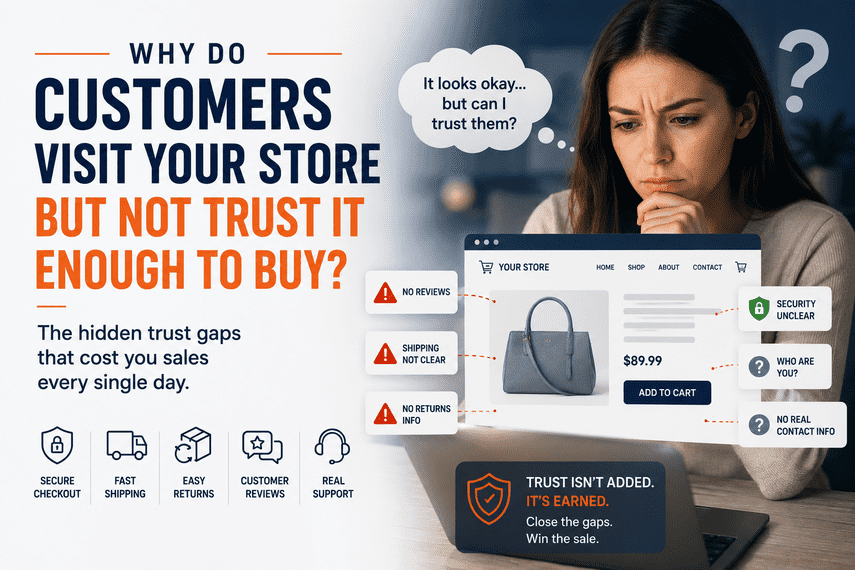

Why Do Customers Visit Your Store But Not Trust It Enough to Buy?
You can have the right products, the right traffic and a working website — yet customers can still leave because they haven't developed enough confidence to buy.
You can have the right products.
You can have the right prices.
You can have good traffic.
You can have a technically functional website.
And customers can still leave without buying.
Sometimes the problem isn't that they don't want the product. It's that they haven't developed enough confidence to buy from you.
A customer may never consciously think:
"I don't trust this website."
Instead, they may think:
"I'll come back later."
Or:
"Let me check another website."
Or they simply close the browser.
And that small moment of hesitation can cost you the sale.
Trust Is Part of the Buying Decision
Think about the last time you bought something online from a store you had never used before.
You probably looked for clues.
Customers don't need to love your website. They need enough confidence to take the next step.
Your Website Is Asking Customers to Take a Risk
Every purchase involves some level of uncertainty.
The customer is trusting you to deliver what you've promised.
"Why should I trust you with my money?"
Your website needs to answer that question throughout the buying journey.
Is It Immediately Clear Who You Are?
Imagine someone lands on your website for the first time.
Within a few seconds, can they understand:
- What your company sells?
- Who you serve?
- What makes you different?
- Where you're based?
- Whether you're a legitimate business?
Or do they have to search for this information?
"I understand who these people are and what they do."
That's the first layer of trust.
Does Your Website Look Credible?
This doesn't mean your website needs to look expensive.
It means it needs to feel intentional, maintained and credible.
Customers don't evaluate these things separately. They form an overall impression.
Can Customers Easily Find Your Contact Information?
If a customer has questions about a purchase, can they easily find:
- Phone number
- Contact form
- Business address
- Support information
They may never actually contact you.
But simply knowing that they can contact you can increase confidence.
"I can clearly see how to contact this company."
Does Your Product Information Create Confidence?
A customer can't physically touch your product.
Your product page has to replace much of that experience.
Customers may want to know:
- What exactly is this product?
- What are its dimensions?
- What materials are used?
- How does it work?
- Who is it suitable for?
- What is included?
- What isn't included?
- How should it be used?
- What makes it different?
If important questions remain unanswered, uncertainty increases.
Are Your Product Images Helping or Creating Doubt?
Images aren't just decoration. They're part of the customer's decision-making process.
Can customers see:
- The product from multiple angles?
- Important details?
- Size and proportions?
- How the product is used?
- Different colors or variants?
- What comes with the product?
"I still don't know what I'm actually getting."
That's a confidence problem.
Are Your Reviews Building Trust?
Reviews can provide something your business can't provide by itself:
Independent evidence.
You're naturally going to say:
"Our product is excellent."
Customers expect that.
What they want to hear is:
"What happened when someone like me bought this?"
Useful reviews help answer questions around:
- Quality
- Fit
- Performance
- Delivery
- Ease of use
- Durability
- Customer service
Do Your Reviews Feel Real?
If every review sounds identical:
"Amazing product!" · "Excellent quality!" · "Highly recommended!"
Customers may not learn much.
Specific reviews are often more useful.
"I bought this for a 12-year-old and the medium size fit perfectly."
The goal isn't simply to show more reviews.
It's to provide useful evidence.
Are You Clear About Shipping?
Shipping uncertainty can stop a purchase.
The earlier you remove uncertainty, the easier it becomes to buy.
Is Your Returns Policy Easy to Understand?
Customers aren't only asking:
"What happens if I love this product?"
They're also asking:
"What happens if I don't?"
Customers want to understand:
- Can I return it?
- Within how many days?
- Who pays return shipping?
- What condition must it be in?
- How will I receive my refund?
- Are there exclusions?
You don't necessarily need a complicated policy.
You need a clear one.
Are You Hiding Important Information?
This can create distrust even when your business is completely legitimate.
"Why didn't they tell me this earlier?"
The problem isn't necessarily the price. It's the surprise.
Transparency builds confidence. Hidden information creates uncertainty.
Does Your Checkout Feel Safe?
The customer has finally decided to buy.
Now they're being asked for:
- Name
- Phone
- Address
- Payment information
Customers need to feel confident that:
The objective isn't to fill the checkout with security badges. It's to create a checkout experience that feels clear, familiar and trustworthy.
Are You Asking Customers to Trust You Too Early?
Some websites immediately ask:
"BUY NOW"
before they've answered the customer's basic questions.
But trust isn't created by a button.
Trust is created by evidence.
Are You Showing Enough Proof?
Customers don't necessarily believe claims simply because a business makes them.
Trust grows when your claims are supported by evidence.
Does Your Website Feel Like a Real Business?
Customers look for signs that there are real people and a real business behind the website.
- About page
- Contact information
- Customer reviews
- Company information
- Physical location
- Business credentials
- Social presence
- Customer support
- Clear policies
- Case studies
- Real product photography
- Helpful content
You don't need every possible trust signal.
You need the signals that are relevant to the risk your customer is taking.
Are You Asking Customers to Make a Big Decision With Too Little Information?
Imagine buying a $10 product.
You may not need much information.
Now imagine buying a:
The level of confidence required is completely different.
The more expensive, complex or risky the purchase, the more evidence customers may need.
Trust is connected to product, price, risk, customer expectations and purchase complexity.
Trust Is Different for Every eCommerce Business
A common mistake is copying trust elements from another website.
"They have a trust badge, so we need one."
Not necessarily.
A customer buying fashion products may care heavily about:
- Reviews
- Returns
- Fit
- Delivery
A customer buying industrial equipment may care more about:
- Specifications
- Certifications
- Technical support
- Warranty
- Company credibility
- Experience
What uncertainty does our customer have before buying?
Then answer that uncertainty.
The Trust Gap
Think about the buying decision this way:
That gap between:
"I want this."
and:
"I'm comfortable buying this."
is extremely important.
The Trust Gap
Your job is to reduce the uncertainty between wanting the product and feeling confident enough to purchase it.
How Do You Know If Trust Is Actually the Problem?
This is where we need to be careful.
Don't redesign your website because someone says:
"The site doesn't look trustworthy."
That's an opinion.
Look at the behavior.
High Product Views + Low Add-to-Cart
This could indicate:
- Product information problems
- Pricing
- Trust
- Poor product-market fit
- Weak value proposition
- Product experience
High Add-to-Cart + Low Checkout Completion
This could point toward:
- Shipping surprises
- Payment problems
- Checkout friction
- Trust
- Unexpected costs
High Traffic + Low Engagement
This may indicate:
- Poor traffic quality
- Landing-page mismatch
- Weak messaging
- Slow experience
Trust can be part of the problem. But it isn't automatically the problem.
Don't change the website until you understand what is actually preventing the purchase.
Try This Simple Exercise
Open your website on your phone.
Imagine you've never heard of your company.
Within 10 Seconds
Do I understand what this business sells?
Within 30 Seconds
Do I understand why I should consider this product?
On the Product Page
Do I have enough information to make a decision?
Before Adding to Cart
Do I know what I'll pay? Do I know when I'll receive it? Do I understand the return policy?
At Checkout
Do I feel comfortable giving this company my information and money?
If you find yourself hesitating at any point, don't immediately change the design. Ask: "Why did I hesitate?"
Trust Isn't Created on One Page
You can't fix trust simply by adding:
"Trusted by 10,000 customers"
to your homepage.
Trust is created across the entire customer journey.
Every step either builds confidence or creates doubt.
Your Website Doesn't Need to Look Perfect
This is important because businesses can easily turn trust into another redesign project.
You don't necessarily need:
- A completely new website
- Expensive animations
- Dozens of trust badges
- A complicated homepage
- A massive redesign
You need to understand where customers are uncertain.
Then remove that uncertainty.
The highest-value improvement isn't always the most visually impressive one.
Trust Is a Business Problem, Not Just a Design Problem
If customers don't trust your store enough to buy, the answer isn't automatically:
"Make the website look better."
The real question is:
What is preventing the customer from feeling confident enough to purchase?
Maybe it's the website.
Maybe it's the product information.
Maybe it's the brand.
Maybe it's pricing.
Maybe it's shipping.
Maybe it's reviews.
Maybe it's the checkout.
Maybe it's the traffic you're attracting.
Maybe it's something else entirely.
Diagnose Before You Redesign
Understanding the real bottleneck is more valuable than simply making changes because something "doesn't feel right."
The Real Goal Isn't "More Trust"
The goal isn't to make customers think:
"Wow, this website has lots of trust badges."
The goal is much simpler:
"I have enough information and confidence to buy."
That's the moment we're trying to create.
Final Takeaway
Customers don't always leave because they don't want your product.
Sometimes they leave because they aren't confident enough to take the risk of buying from you.
And they may never tell you that.
That's why trust needs to be considered throughout the entire eCommerce journey.
Look at your brand credibility, product information, images, reviews, pricing, shipping, returns, contact information, checkout and payment experience.
But don't blindly add more elements.
First ask:
What uncertainty is stopping this customer from buying?
Then fix that.
Because the goal isn't to make your website look more trustworthy.
The goal is to give customers enough confidence to complete the purchase.
Is Trust Really the Problem?
If customers are visiting your store but not buying, trust may be one part of the problem.
But it could also be traffic quality, mobile experience, product discovery, product-page friction, performance, cart abandonment, checkout problems, technology, or something else in the customer journey.
The important question isn't:
"What should we improve?"
It's:
"What is actually preventing more of our traffic from becoming revenue?"
Find What May Be Holding Your Store Back