
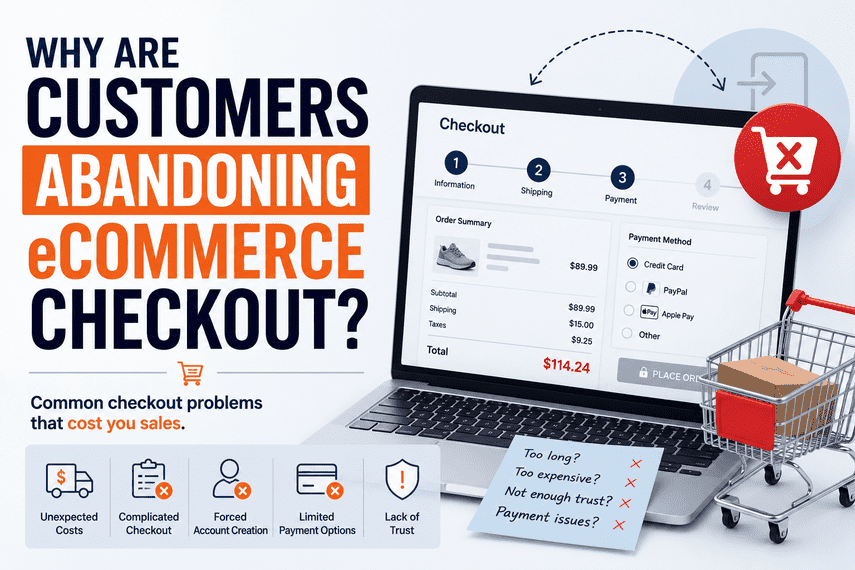

Why Are Customers Abandoning eCommerce Checkout?
Customers are reaching checkout but not completing their purchase? Discover what may be creating friction at the final stage of the buying journey.
A customer finds your store.
They find the product they want.
They read the product information.
They decide to buy.
They add the product to their cart.
And then they reach checkout...
And leave.
For an eCommerce business, this can be particularly frustrating because the customer has already shown strong purchase intent.
They weren't just browsing anymore.
They were close to becoming a customer.
So what happened?
"They changed their mind."
Sometimes they did.
But sometimes the checkout experience itself gave them a reason to stop.
And that's why checkout abandonment deserves a closer look.
The Final Step Can Still Break the Purchase
Think about the customer journey:
By the time someone reaches checkout, they've already passed through several stages of the buying journey.
They've found your store.
They've evaluated your products.
They've considered the price.
They've decided that the product is worth buying.
Now they're being asked to complete the transaction.
Make completing the purchase clear, easy and predictable.
Unexpected Costs Appear at Checkout
One of the simplest reasons customers abandon checkout is also one of the most frustrating.
The customer sees a product for one price. They add it to the cart. Then they reach checkout and discover:
- Shipping costs
- Taxes
- Handling fees
- Additional charges
- Delivery fees
The total is suddenly higher than expected.
The customer may still want the product. But they may no longer want the purchase at that total cost.
The customer didn't necessarily change their mind about the product. They changed their mind about the overall transaction.
Ask yourself: Is the total cost clear early enough in the buying journey?
Checkout Is Asking for Too Much Information
Customers expect to provide some information when placing an order.
But there is a difference between necessary information and unnecessary friction.
Checkout may ask for:
- Multiple address fields
- Unnecessary personal information
- Account details
- Additional preferences
- Information that isn't actually required
Every additional field creates another interaction.
And every unnecessary interaction creates another opportunity for the customer to stop.
Only ask the customer for what is necessary to complete the purchase.
Customers Are Forced to Create an Account
Imagine being ready to buy something online.
You've already decided what you want. You've entered your information.
Then the store tells you:
"Create an account before you can continue."
Some customers won't mind. Others will.
Especially first-time customers who don't yet have a relationship with your business.
They may simply think:
"I don't want another account."
If account creation isn't essential to the transaction, consider whether customers should be able to complete their purchase without creating an account.
Customers Don't Know When Their Order Will Arrive
Customers aren't only buying a product.
They're also buying an expectation of delivery.
If these answers aren't clear, uncertainty enters the purchase decision.
Good checkout communication doesn't necessarily require more content. It requires the right information at the right moment.
The Payment Options Don't Work for the Customer
Imagine reaching the final step of checkout and discovering that your preferred payment method isn't available.
You may still want the product. But completing the purchase now requires additional effort.
Depending on the market and customer base, expectations around payment can be very different.
Do we offer the payment methods our customers actually expect to use?
And there's another issue: payment reliability.
A customer may have every intention of purchasing, but a failed payment can turn that intention into abandonment.
Checkout Doesn't Work Well on Mobile
A checkout that works reasonably well on a desktop may become frustrating on a phone.
- Difficult form fields
- Small buttons
- Awkward dropdowns
- Poor keyboard behavior
- Slow-loading pages
- Payment problems
- Confusing navigation
- Long forms
The customer isn't thinking:
"This checkout has poor mobile UX."
They're thinking:
"This is annoying."
And sometimes they simply leave.
Customers Don't Feel Enough Trust at the Final Moment
Trust matters throughout the buying journey.
But it can become especially important when the customer is about to provide payment information.
They may want reassurance about:
- Payment security
- Returns
- Refunds
- Delivery
- Customer support
- Company legitimacy
- Order protection
If the checkout experience suddenly feels unfamiliar, confusing or unreliable, the customer's confidence can drop.
Don't assume trust is established just because the customer reached checkout.
The Checkout Experience Is Too Complicated
Sometimes there isn't one obvious problem.
The entire checkout simply feels difficult.
A Complicated Checkout Might Look Like This
None of these steps may be individually terrible.
But together they create unnecessary effort.
The customer may simply start thinking: "Why is this taking so long?"
Customers Encounter Technical Errors
This is one of the most important things to investigate because the customer may be completely ready to buy.
Then something breaks.
- Payment fails
- Shipping options don't load
- A form doesn't submit
- An address isn't accepted
- The page reloads unexpectedly
- The cart changes unexpectedly
- An error message appears
- The checkout gets stuck
From your analytics, you may simply see:
Checkout abandoned.
But the customer experienced:
"I tried to buy this, and your website wouldn't let me."
That is a very different problem.
Coupon Codes Can Create the Wrong Behavior
A customer reaches checkout and sees:
"Have a coupon code?"
They don't have one.
So what do they do?
They open Google. They search for a discount code.
Now they're no longer focused on completing your checkout.
They may find a competitor. They may find an expired coupon. Or they may decide to wait for a promotion.
Discounts can absolutely be useful.
But is your checkout encouraging customers to complete purchases—or encouraging them to search for a better deal?
The Checkout May Be Slow
A customer who has already decided to purchase is particularly sensitive to unnecessary delays.
Imagine:
At this point, the customer isn't evaluating your product anymore.
They're evaluating the experience of buying from you.
Not Every Abandoned Checkout Is a Problem
We shouldn't assume every abandoned checkout means your checkout is broken.
Some customers are comparing prices, waiting for payday, discussing the purchase, saving the product or simply deciding whether they really need it.
Some abandonment is normal.
The goal isn't necessarily to eliminate abandonment completely.
The goal is to understand which abandonment represents lost business that you can realistically influence.
Don't Immediately Redesign Your Checkout
When businesses discover high checkout abandonment, a common reaction is:
"Let's redesign checkout."
But that may be the wrong first move.
Before changing anything, ask:
Where Exactly Are Customers Dropping?
These are different problems.
And they may require completely different solutions.
What Should You Investigate First?
If customers are reaching checkout but not completing their purchases, I'd start with these questions.
Don't Optimize Checkout Based on Opinions
This is where eCommerce teams can get stuck.
Someone says: "The checkout looks too long."
Another person says: "We should add more payment methods."
Someone else says: "Let's remove this field."
Another says: "Let's redesign the whole thing."
Everyone has an opinion.
What does the customer behavior actually tell us?
Use your data to identify where the problem appears.
Then use customer behavior, technical analysis and business context to understand why.
Then decide what to change.
The Bigger Question Isn't "How Do We Reduce Abandonment?"
It's:
Why Are Customers Who Intended to Buy Not Completing the Purchase?
That's a much more useful question.
Because the answer could be:
- Price
- Shipping
- Trust
- Payment
- Mobile experience
- Technical failure
- Complexity
- Or simply that the customer wasn't ready
Until you understand which one you're dealing with, it's difficult to know what you should fix.
Your Checkout Is Part of Your Sales Experience
It's easy to think about checkout as a technical process.
The customer enters information. The payment gets processed. The order is created. Done.
But from the customer's perspective, checkout is something else.
It's the final stage of the buying experience.
They've already decided:
"I want this."
Now they need to feel:
"I'm comfortable completing this purchase."
Your checkout should make that decision easier, not harder.
Final Takeaway
If customers are reaching checkout but not completing their purchases, don't immediately assume they simply changed their minds.
And don't immediately rebuild your checkout.
First find out:
Where are they leaving?
When are they leaving?
What are they experiencing?
And what does the data tell you about why?
The objective isn't simply to make checkout shorter.
It's to remove the friction that is actually preventing the right customers from completing their purchase.
Is Checkout Abandonment Part of a Bigger Conversion Problem?
If customers are reaching your checkout but too few are becoming customers, checkout may be one part of a larger eCommerce conversion problem.
Your store may be losing revenue earlier in the journey too—from product discovery and product pages to mobile experience, cart, trust and customer experience.
The important question isn't simply what you can improve.
It's what you should fix first.
Explore the Bigger Problem