
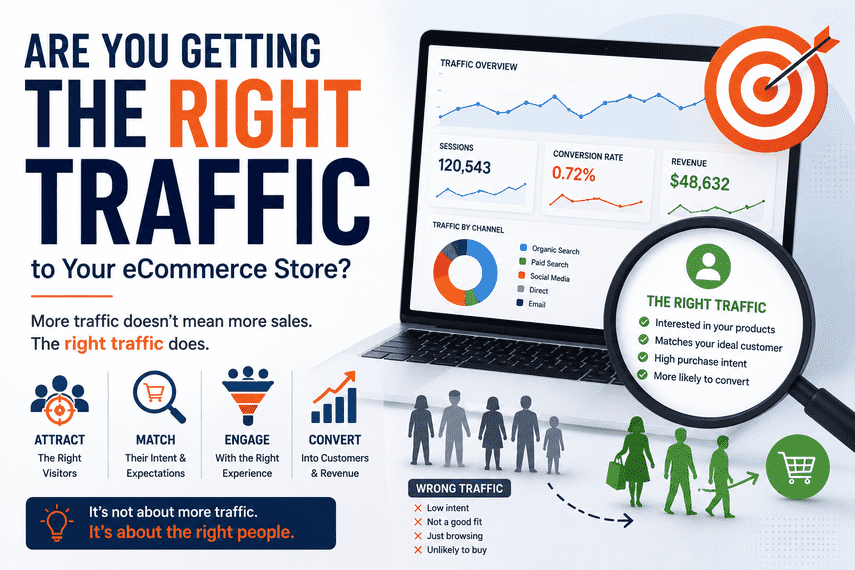

Getting traffic but not enough sales? The problem may not be how much traffic you're getting, but whether you're attracting the right people.
More traffic sounds like the obvious answer to an eCommerce growth problem.
Your sales aren't growing?
Get more visitors.
Your conversion rate is low?
Run more ads.
Organic traffic has slowed down?
Invest more in SEO.
But are you actually getting the right people to your eCommerce store?
Because 100,000 visitors don't necessarily mean 100,000 opportunities.
If the people arriving at your store aren't interested in what you sell, aren't ready to buy, or don't match your ideal customer, increasing traffic may simply increase the number of visitors who don't convert.
The goal isn't just more traffic. The goal is more relevant traffic that has the potential to become revenue.
More Traffic Doesn't Automatically Mean More Revenue
Imagine two eCommerce stores.
| Store | Visitors | Conversion Rate |
|---|---|---|
| Store A | 100,000 | 0.5% |
| Store B | 30,000 | 2.5% |
Store A gets more than three times as much traffic.
But Store B may be generating significantly more customers from a much smaller audience.
That's why traffic volume by itself can be misleading.
What is the quality of the traffic we're attracting?
What Is "The Right Traffic"?
The right traffic isn't simply people who clicked on your website.
It's people who are more likely to:
- Need what you sell
- Be interested in your products
- Match your target customer
- Have a relevant reason for visiting
- Be at an appropriate stage of the buying journey
- Have enough purchase intent to potentially convert
Consider two searches.
Different Search Intent
"How to clean leather shoes"
"Buy leather shoes online"
Both searches can bring visitors to a shoe store. But their purchasing intent is very different.
Neither visitor is necessarily "bad."
But they represent different types of traffic.
And your marketing strategy should understand that difference.
Are Your Visitors Actually Looking for What You Sell?
This sounds obvious.
But it's surprisingly easy to attract people who aren't a good fit for your products.
This can happen through:
- Broad advertising audiences
- Generic keywords
- Poorly targeted campaigns
- Misleading content
- Overly broad SEO topics
- Social campaigns designed primarily for clicks
- Promotional messaging that attracts bargain hunters
Who exactly are the people visiting our store?
And:
Why are they coming?
Does Your Advertising Promise Match Your Website?
Imagine an advertisement says:
"20% Off Running Shoes — This Week Only."
The customer clicks.
But instead of seeing the relevant running shoes and the offer they expected, they land on your homepage.
Now they have to:
Every additional step creates friction.
The traffic may be completely relevant. The problem may be the experience after the click.
So don't evaluate advertising only by: How many clicks did we get?
Also ask: What happened after those clicks?
Are Your SEO Visitors Looking for Information or Products?
SEO can generate enormous amounts of traffic.
But not all organic traffic has the same commercial value.
Different Levels of Intent
Informational: "What is Magento?"
Commercial: "Magento development company"
High commercial intent: "Best Magento migration agency"
The point isn't to eliminate informational traffic.
Informational content can be extremely valuable for building authority and introducing people to your brand.
The point is to understand the difference between:
Traffic and commercially relevant traffic.
Are You Measuring Traffic Quality?
Many businesses monitor:
- Visitors
- Sessions
- Pageviews
And that's useful.
But those numbers don't tell you enough about whether the traffic is helping the business grow.
Follow the Entire Journey
The further you follow the journey, the more useful the analysis becomes.
Look at Traffic by Channel
One of the easiest ways to discover traffic-quality problems is to compare your acquisition channels.
| Channel | Traffic | Conversion |
|---|---|---|
| Organic Search | High | Low |
| Paid Search | Medium | High |
| Social | Very High | Very Low |
| Low | Very High |
A common reaction might be:
"Social is our biggest source of traffic. Let's invest more there."
But that's not necessarily the right conclusion.
Social may be generating huge numbers of visitors but very little revenue.
Email may generate far fewer visitors but significantly more customers.
Which channels bring visitors who create the most business value?
Are You Attracting the Right Customers but Sending Them to the Wrong Page?
Let's say someone searches for:
"Black leather office chair."
They click your ad.
But instead of landing on the relevant product category, they arrive at your homepage.
The visitor may still be the right customer.
But you've made them work to find what they came for.
A Better Journey
Getting the right traffic is only half the job. You also need to give that traffic the right next step.
Are Your Marketing Messages Attracting the Wrong Expectations?
Your marketing message creates an expectation before the visitor reaches your store.
If that expectation doesn't match reality, conversion can suffer.
When the promise and the experience don't match, customers can lose confidence.
Marketing promise → Landing page → Product experience → Purchase
Each step should feel like a continuation of the previous one.
Are You Optimizing for Clicks Instead of Customers?
This is a particularly important distinction.
A campaign can produce low-cost clicks and still be a poor campaign.
| Campaign | Clicks | Purchases |
|---|---|---|
| Campaign A | 10,000 | 50 |
| Campaign B | 3,000 | 150 |
Campaign B generated fewer clicks.
But it generated three times as many purchases.
The business doesn't need clicks. The business needs profitable customers.
What Happens After the Traffic Arrives?
This is where traffic quality connects to the broader conversion problem.
Suppose you've determined that your traffic is actually relevant.
People are searching for your products.
Your advertising is well targeted.
Your landing pages are relevant.
But sales are still low.
Traffic May Not Be the Main Problem
Now you can investigate what happens further down the funnel.
Traffic → Product Discovery → Product Page → Cart → Checkout → Purchase
If traffic is good but customers aren't progressing, ask:
Where are we losing them?
Don't Increase Your Traffic Budget Until You Understand Your Current Traffic
This doesn't mean you should stop marketing.
It means you should understand what you're buying.
Before increasing your advertising or SEO investment, ask:
Traffic Quality Isn't Just a Marketing Problem
Even when traffic is the right traffic, the website still has to convert it.
A weakness anywhere in that journey can reduce the value of the traffic you're paying for.
Don't Chase Traffic for the Sake of Traffic
More traffic is attractive because it's easy to see.
You can look at your analytics and say:
"We grew traffic by 30%."
That sounds like progress.
But if revenue grew by only 5%, you should ask why.
Maybe the additional traffic wasn't as relevant.
Maybe conversion declined.
Maybe customers couldn't find what they wanted.
Maybe the product experience created friction.
Maybe checkout became a problem.
Or maybe the business attracted more visitors but not more buyers.
Traffic growth and business growth aren't the same thing.
The Better Question
Are we getting the right people to our store?
Then ask:
What are those people doing once they arrive?
And finally:
How much revenue are we generating from that opportunity?
These questions move you from traffic reporting to business analysis.
And that's where better eCommerce decisions start.
Final Takeaway
Your eCommerce store doesn't necessarily need more traffic.
It may need better traffic.
Or the traffic you're already getting may actually be good—but you're losing those customers somewhere else in the buying journey.
Before increasing your marketing spend, understand:
Who is visiting?
Why are they visiting?
What are they looking for?
What do they do after they arrive?
Which channels actually produce customers and revenue?
Because the goal isn't:
More visitors.
The goal is:
More of the right visitors becoming customers.
Are You Getting Traffic but Not Enough Revenue?
Traffic quality may be one part of the problem. But it may not be the only one.
Your store may have issues with customer experience, product discovery, performance, cart, checkout, technology or other parts of the eCommerce journey.
The important question isn't simply what you can improve.
It's what you should fix first.
See Where Else You Could Be Losing Customers →