
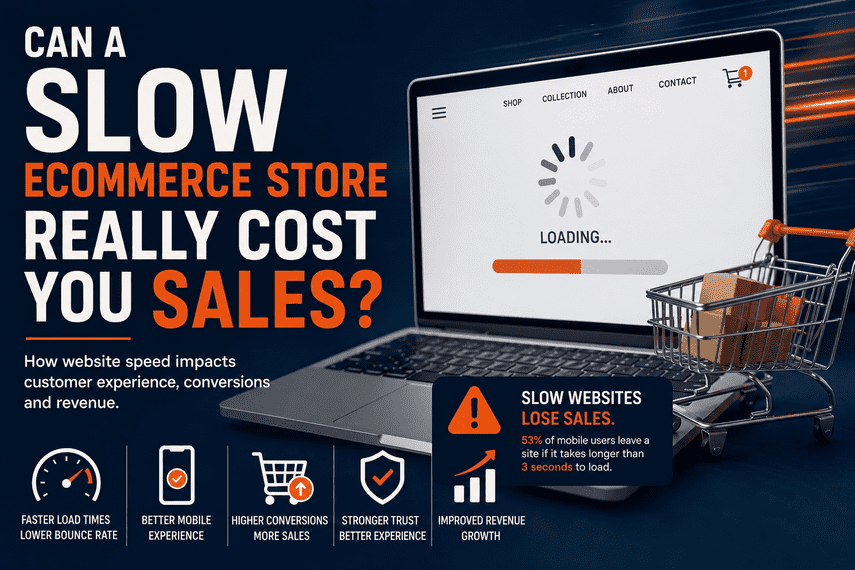

Can a Slow eCommerce Store Really Cost You Sales?
Your website may be working perfectly and still be creating enough friction to affect customer behavior. Here's how to determine whether performance is actually affecting your revenue.
You may have checked your eCommerce website yourself.
It loads.
The pages work.
The products appear.
Checkout works.
So you might think:
"Our website isn't really slow."
But that's not necessarily how your customers experience it.
A customer doesn't care whether your server responded within a certain technical benchmark.
They care about something much simpler:
"How quickly can I do what I came here to do?"
If they have to wait, wait again, and wait again throughout their journey, that friction can affect whether they continue toward a purchase.
Website performance isn't just a technical issue. It can become a business issue.
Your Website May Feel Fine to You
There's an important reason business owners often underestimate performance problems.
You know your website. You've used it hundreds of times. You know where everything is.
You may also have a fast internet connection. You may be visiting from a desktop computer.
Your customer may have a completely different experience.
And they're not necessarily going to wait patiently.
They have alternatives.
Customers Don't Experience Your Website the Way You Do
Imagine a customer searching for a product.
They click your advertisement.
The page starts loading.
They wait.
The product images appear.
They scroll.
Another element loads.
They click a variant.
The page responds slowly.
They add the product to cart.
The cart takes a moment to update.
They continue to checkout.
Another delay.
None of these individual delays may seem catastrophic.
But the customer experiences them one after another.
The customer may never tell you: "Your website was too slow." They simply don't buy.
Speed Isn't Just About a Page Loading
When people talk about website speed, they often think about one number:
PageSpeed Score
But that's only part of the picture.
A customer experiences several things.
The real question isn't "Is my website technically fast?" It's "Is the experience fast enough for customers to continue buying?"
Why Mobile Performance Matters
A customer may discover your product on their phone.
They may click an advertisement, browse several products, compare prices, add something to the cart and complete the purchase on the same device.
Your mobile experience isn't a smaller version of your desktop experience. For many customers, it is the experience.
Your Desktop Website Can Hide Problems
Imagine your desktop website loads quickly.
"Performance isn't a problem."
But then look at the same journey on a mobile device.
The website may technically work. But the customer is experiencing friction.
The First Few Seconds Matter
Imagine a customer arrives at your website from Google or an advertisement.
They don't have a relationship with your brand yet. They're evaluating you.
If the page takes too long to become useful, they may leave before they've even seen what you sell.
The problem isn't only website performance.
It's the relationship between performance and acquisition economics.
Slow Product Pages Can Interrupt Buying Intent
A customer has already found a product they're interested in.
They're now trying to make a decision.
They want to:
- See images
- Read information
- Select options
- Check availability
- Review delivery
- Read reviews
- Add to cart
If the product page is slow or interactions feel delayed, the buying process becomes harder.
"This is taking too long."
Once momentum is lost, the customer may leave.
Slow Search and Filtering Can Be Even Worse
Imagine a customer knows approximately what they want.
They don't want to browse hundreds of products. They want to use search or filters.
They enter a search.
Nothing happens immediately.
They wait.
Results appear.
They select a filter.
Another delay.
The customer isn't simply experiencing a slow page. They're experiencing a slow shopping process.
The goal of an eCommerce website is not just to display pages quickly.
It's to help customers find and buy products efficiently.
What Happens When Checkout Becomes Slow?
This is where performance becomes particularly important.
"I'm going to buy."
Now imagine the checkout is slow.
They click the next step. Nothing happens immediately.
They click again. They wonder whether the button worked.
A payment option takes time to load.
An address field behaves strangely.
The order takes a long time to process.
The customer's confidence can start to decline.
At checkout, performance isn't simply affecting convenience. It may be affecting purchase completion.
Third-Party Scripts Can Quietly Add Friction
Many eCommerce stores have a large number of external tools.
Each tool may have a legitimate business purpose.
The problem is when the combined technical impact becomes significant.
Individually they may not look like a big problem. Together they can contribute to a heavier customer experience.
A Good PageSpeed Score Doesn't Tell the Whole Story
Performance tools are useful. They can help identify technical problems.
But don't turn the score into the objective.
Imagine improving your score from 72 to 94.
Sounds great.
But what if:
- Conversion hasn't improved
- Mobile abandonment hasn't changed
- Product interactions are still slow
- Checkout is still frustrating
- Customers are still leaving
You have improved a technical metric without necessarily solving the business problem.
The objective isn't a perfect score.
The objective is a better customer experience that supports business performance.
Your Website Can Be Fast in One Place and Slow in Another
Performance isn't always consistent.
This is why checking your website once on your own computer isn't enough.
You need to understand what customers experience across important journeys.
How Do You Know If Performance Is Actually Hurting Your Store?
Don't assume:
"Our website is slow, therefore that's why sales are low."
That's not a diagnosis.
Look at your data.
Desktop vs Mobile
Is conversion significantly different?
Fast vs Slow Pages
Do pages with longer loading or interaction times show weaker engagement?
Product Pages
Are customers reaching product pages but failing to progress?
Cart
Are customers adding products but abandoning before checkout?
Checkout
Are there unusual drop-offs at specific steps?
Traffic Sources
Do certain campaigns have much weaker conversion?
Diagnose Before You Optimize
Patterns in customer behavior can help determine whether performance is actually connected to the business problem.
Don't Optimize Everything
A business discovers that its website has performance issues.
Then the response becomes:
"Let's optimize everything."
That can become expensive very quickly.
Some of these changes may be useful.
Which performance problem deserves attention first?
Find the Bottleneck
Imagine your customer journey looks like this:
Now imagine the biggest performance problem isn't the homepage.
It's checkout.
Would spending weeks optimizing the homepage be the best business decision?
Probably not.
Or perhaps your website is technically fast, but product discovery is extremely difficult.
In that situation, performance may not be the biggest growth constraint at all.
That's why diagnosis matters.
Performance Is a Business Problem, Not Just a Developer Task
It's easy to give performance entirely to the development team.
The business says:
"Make the website faster."
The developer starts optimizing.
But the more important conversation is:
"Where is performance affecting the customer journey, and what business outcome are we trying to improve?"
That changes the discussion.
What Should You Check First?
If you believe your eCommerce store may have performance problems, don't start by changing technology.
Start by understanding the experience.
Don't Confuse a Technical Problem With the Business Problem
Suppose your store is slow.
That's a technical problem.
But the business problem might be:
Performance may be one of the causes.
But you need to establish that connection.
Otherwise you can spend a lot of money making a website technically better without meaningfully improving the business.
Sometimes the Biggest Problem Isn't Speed
You may spend weeks improving website performance and discover that conversion barely changes.
Why?
That's why we shouldn't automatically treat every technical issue as the biggest growth opportunity.
Knowing what not to fix can save your business just as much as knowing what to fix.
The Right Question
Don't ask:
"Is our website slow?"
Ask:
"Where is website performance creating friction in the customer journey, and is that friction affecting revenue?"
That question connects:
Performance Should Support Growth
A high-performing eCommerce website isn't simply one that gets a good technical score.
It's one that allows customers to move through the buying journey without unnecessary friction.
Performance supports every one of these steps.
When the experience slows down, the customer journey can slow down with it.
Final Takeaway
A slow eCommerce store can cost you sales.
But the answer isn't simply to chase a better PageSpeed score.
The more important question is:
Where is performance affecting your customers?
Look at mobile experience, landing pages, product pages, search, filtering, cart, checkout, third-party scripts, integrations, extensions and server-side performance.
Then connect those technical observations to actual customer behavior and business outcomes.
Because the goal isn't:
"Make the website faster."
The goal is:
"Remove the performance problems that are preventing customers from moving toward a purchase."
And sometimes you'll discover that performance isn't the biggest problem at all.
That's valuable too.
Is Website Performance Really Holding Your Store Back?
If your eCommerce store isn't growing the way you expect, speed may be part of the problem.
But it could also be traffic quality, customer trust, mobile experience, product discovery, product-page friction, cart abandonment, checkout problems, technology, operations, or something else.
The important question isn't:
"What should we improve?"
It's:
"What is actually preventing more of our traffic from becoming revenue?"
Find What May Be Holding Your Store Back