
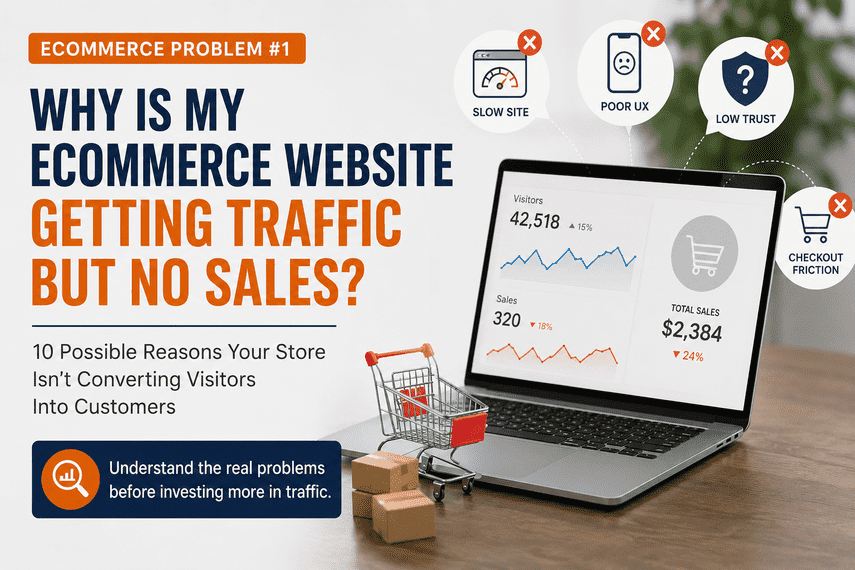

Why Is My eCommerce Website Getting Traffic But No Sales?
Getting traffic is only the beginning. If visitors are arriving but sales aren't growing, the problem may be somewhere inside the customer journey.
You're getting traffic.
People are finding your website through Google, paid advertising, social media, email campaigns or other channels.
But the sales aren't where you expected them to be.
"If people are coming to our store, why aren't more of them buying?"
The first instinct is often to get more traffic. More SEO. More advertising. More campaigns.
But before you spend more money bringing people to your store, there is another question worth answering.
What is happening to the visitors you already have?
If your store is getting qualified traffic but a large percentage of those visitors aren't becoming customers, acquiring even more traffic may not solve the underlying problem.
The opportunity may already be inside the customer journey you have.
Traffic Is Only the Beginning
A simplified eCommerce journey looks like this:
Your Traffic May Not Be the Right Traffic
One possible explanation is that the visitors reaching your store simply aren't the people most likely to buy.
You may be attracting visitors who are:
- Researching rather than purchasing.
- Looking for information rather than products.
- Interested in a different product or category.
- Outside your target geography.
- Coming from poorly targeted advertising.
- Responding to a message that doesn't match the landing page.
This creates an important distinction:
High traffic does not necessarily mean high buying intent.
Before asking how to get more visitors, understand who your current visitors are and what they are trying to accomplish.
Customers May Not Understand Your Product Quickly Enough
Once someone arrives, they need to understand what you're offering.
Especially on product pages, customers may be asking:
A product page isn't simply a place to display a product. It is part of the sales process.
What it is → Why it matters → Why it's right for them → Why they should trust you → What to do next.
Customers May Not Trust the Store Enough to Buy
A customer can want your product and still decide not to purchase.
Buying online requires trust.
- Reviews and ratings.
- Product feedback.
- Clear shipping information.
- Return policies.
- Payment options.
- Guarantees.
- Company information.
- Contact details.
- Secure checkout.
Sometimes the problem isn't:
"I don't want this product."
It is:
"I'm not confident enough to buy it from this company."
Your Store May Create Too Much Friction
Customers don't visit an eCommerce store because they want to navigate a website.
They want to find something, understand it and decide whether to buy it.
- Confusing navigation.
- Difficult product discovery.
- Poor search.
- Unclear categories.
- Too many popups.
- Distracting elements.
- Unclear calls to action.
- Complicated forms.
- Unnecessary steps.
- Difficult filtering.
- Confusing checkout.
The question isn't simply whether your website looks good.
How easy is it for the right customer to move from interest to purchase?
Your Mobile Experience May Be Different
Your website may work well on a desktop computer and still create problems for mobile customers.
- Slow mobile pages.
- Difficult navigation.
- Small controls.
- Awkward forms.
- Difficult product image interaction.
- Intrusive popups.
- Difficult filtering.
- Checkout friction.
Your development team doesn't experience the store exactly as your customers do.
Customers experience it through their device, connection, environment and intent.
Customers May Be Adding Products to Cart but Not Completing the Purchase
If customers are adding products to their carts but not completing orders, you have an important signal.
At least some visitors have demonstrated buying intent. The problem may be occurring later in the journey.
- Unexpected shipping costs.
- Taxes or additional charges appearing late.
- Complicated checkout.
- Forced account creation.
- Limited payment options.
- Unclear delivery information.
- Trust concerns.
- Slow checkout.
- Technical errors.
This is why overall conversion rate isn't always enough.
You need to understand where the customer journey is breaking down.
Your Store May Be Too Slow
Performance can affect the buying experience.
A slow homepage is frustrating. A slow product page can interrupt product evaluation. A slow cart can create friction. A slow checkout can become particularly damaging when purchase intent is already high.
Don't Optimize Only for a Technical Score
The business question isn't simply: "How do we get a better performance score?"
The better question is: "Is store performance creating meaningful friction for our customers?"
This means understanding which pages, devices and customer journeys are actually affected.
There May Be More Than One Problem
This is where eCommerce conversion problems become difficult.
Conversion may be affected by a combination of:
Improving one area doesn't necessarily solve the entire problem if another major constraint remains.
That's why jumping directly to a solution can be risky.
Don't Immediately Assume You Need a Website Redesign
When sales are disappointing, one of the easiest conclusions is:
"We need a new website."
Sometimes that is the right answer. But it shouldn't automatically be the first answer.
Before committing to a redesign, ask:
- What exactly isn't working?
- Where are customers dropping off?
- Is the problem visual, functional, technical or commercial?
- Is it affecting all customers or a particular segment?
- What evidence supports the conclusion?
- Could a smaller change solve the problem?
- What would success look like?
The same principle applies to platform migrations.
Don't start with "Should we change platforms?" Start with "What business problem are we trying to solve?"
Before Spending More on Traffic, Look at the Traffic You Already Have
This is one of the most important questions an eCommerce business can ask:
What happens after someone arrives at our store?
Look at the complete journey:
The Important Question
There are dozens of possible problems.
The difficult part isn't finding things that could be improved.
The difficult part is determining:
Which problem is actually affecting your business the most?
A Better Way to Diagnose the Problem
The Question Isn't Always "How Do We Get More Traffic?"
If your eCommerce store is getting traffic but not enough sales, the most important question may not be:
"How can we get more visitors?"
It may be:
"Why aren't more of the people already visiting our store becoming customers?"
That question changes the conversation.
Instead of automatically spending more on acquisition, you start examining the entire customer journey.
Instead of immediately rebuilding the website, you understand the problem first.
Instead of adding another feature, you determine whether that feature addresses an important constraint.
Instead of guessing, you use evidence.
You May Have a Conversion Problem — But Which One?
Getting traffic but not enough sales is a symptom. The cause could be traffic quality, product experience, trust, mobile experience, performance, checkout, or something else inside the customer journey.
The important question isn't how many problems you can find.
It's which problem is actually affecting your business the most.
Find Out What's Actually Happening →Final Takeaway
If your eCommerce website is getting traffic but not generating enough sales, don't automatically assume the answer is more traffic.
Understand where the customer journey is breaking down, identify why it's happening, and determine what deserves attention first.
The biggest opportunity may not be getting more people to your store.
It may be helping more of the right people who are already there become customers.
And before deciding what to fix, first understand what is actually holding your store back.
